Rio at 2x speed
I arrived in Rio de Janeiro at 18 with a dream that was simple to say and heavy to carry: having my own agency. It worked. We worked with Anitta through the first four years of her career, before her first show. Chico Buarque, Maria Bethânia, more than 150 Brazilian artists. For a few years, every Warner Music Brasil release went through us. From the tiny office I moved to the fancy office, a six-thousand-real chair, expensive computers. I wanted to run the biggest digital marketing agency in Brazil.
Except artists like to start working at four in the afternoon. So the middle of the night was my rush hour. I worked, worked, worked, worked, worked. Lived with my heart racing. Spent the whole day on my phone. Treated people badly — "everyone was stupid, nobody understood anything." I developed a persecution complex: I would walk down the street convinced I was about to run into a client demanding something.
There is a photo of me from that time with my nephew on my lap. Wide open smile, teeth showing. But I know myself. I know my own face. I was not well. So much so that I stopped by my sister's house every single day to play with him — that was my moment of happiness. The rest was life at 2x, like a sped-up WhatsApp voice note: you could understand everything except the meaning.
Do you know the face you make when you are not well?
It was a transition, not a break. It took about six years.
The crossroads
The great change in my life came from a crossroads: depression and anxiety together — what doctors call comorbidity. The day I saw I was unwell, truly unwell, I sought therapy. And the therapist opened the conversation with a prescription of almost offensive simplicity: "Go walk. Go burn some energy."
I went. And here is the part nobody likes to tell, because it ruins the magic-turnaround story: there was no magic turnaround. It was a transition, not a break. It took about six years. I kept incorporating things, one at a time. The persecution complex became walking. The phone all day became yoga. The harsh way of treating people became the study of spirituality. The racing heart became meditation. Having no time for myself became cooking my own food. Working all day became having working hours. Six years, one step at a time — and I say this with full awareness: people going through material hardship cannot afford to keep tending to emotional matters. Being able to think about this is a privilege.
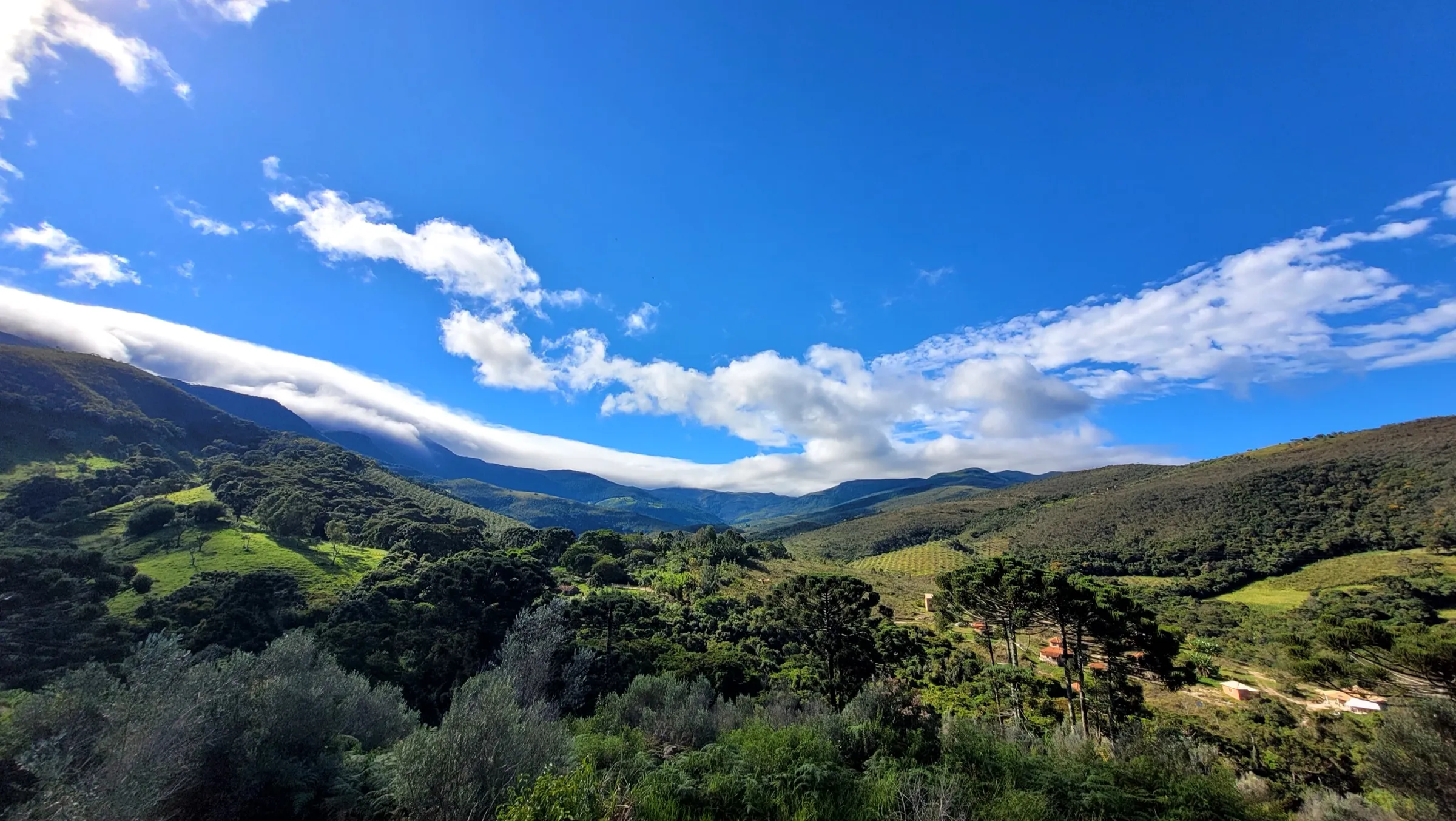
At the height of the crisis, I spent a week here at Céu do Gamarra and left renewed. You know when you come back from a few days of rest and three days later you are back in the mud? Exactly. In the mud, I set the photo of the mountain as my computer wallpaper and said: "That is the view I had at the guesthouse, and that is the view I need to carry inside me."
The phone call
Then came the pandemic. The world stopped, the agency closed the office and went fully remote. One morning, finishing my meditation while watching the sun rise over Rio, I called Carol Pedalino — from the same Pedalino family as my first remote job, at 16, when I updated the Los Hermanos website from Caxambu. "Carol, let me spend a few days there at the guesthouse." She answered: "Derick, we're opening a retreat called Residências Regenerativas. Come on over, we're opening today."
And so I went. I told the friend who shared the apartment with me: "I'll spend two months, maybe stretch it to three, but maybe I'll only come back to pick up my things and move there." And so it was. On the way out of Rio, the moving truck ended up in a back alley, two kids with a rifle... and a deliverance. "You can go, boss." And I came. In January 2021 I arrived at Espaço Lua Branca, inside the ecovillage, for a three-month residency that never ended.
Now, an honest warning, one I wrote in my very first weeks here: living in nature does not solve your problems. It looks romantically perfect, but it is not the answer to everything. Being in the middle of the woods does not shrink your to-do list — it does help you, enormously, to focus on it. So much so that, two years after arriving, I had a burnout right here, surrounded by birdsong. I lost focus. I gave too much to work. I asked for help. I was helped. I helped, too. The mountain is not anesthesia. It is horizon.
The community
The Céu do Gamarra Ecovillage has existed for almost forty years, in the valley of the Gamarra river, in rural Baependi, southern Minas — land that belonged, before us, to the Indigenous people of the Cataguá nation. It was founded by Fábio and Suzana Pedalino, who left Rio de Janeiro to build this story in the mountains. Suzana sums up their decision in a sentence I envy for its simplicity: "My heart always belonged to the mountains."
An ecovillage, here, is two things: a group of people who decide to live together in nature, and a shared ideal — in our case, a spiritual quest. It was by living here that I discovered we all live in community. When you are in a big city, you are in a community. But here it is an intentional community: we hold the intention of being together in one single direction.
And life here is less idyllic and more fun than it looks from the outside. There is the Sunday work-party, everyone with a hoe in hand — we fix what is ours. There is the cheesy-music party at the barn, because country life is livelier than you'd think. There is a traveling clown staying at the house. There is a carcará pecking at the glass door in the morning. There is a neighbor who makes award-winning organic olive oil. There are kids running free, growing up in a kind of safety the city no longer offers, raised a little by everyone — and teaching me to say "de agora em diantes," their own plural of "from now on." There is also the silence, the one the city never lets you hear.
The center of my life is my life, not my work.
The work that fell into orbit
Plenty of people asked how the adman could possibly work from there. Well: I grabbed the chair and the desk, pulled them over, and started working from there. At the start of the pandemic, half the agency's team already worked remotely; when everything went remote, I saw the whole operation ran perfectly well in the virtual environment — and soon realized I, too, could work from anywhere. The internet that saved me at 12, when a femur problem locked me at home and the computer became my world, is the same one that lets me live here.
And the opposite of what the skeptics expected happened: my productivity went up. Being in harmony with nature, seeing the starry sky, almost no pollution — it is invigorating. You connect more with yourself, so you can give yourself fully to the day's activities. So the results are better too. A person at peace with themselves works better. That is what I encourage for myself and for the people who work with me.
In Rio, work was the center — and everything else orbited it. Here, it flipped. The work goes on, strong: I still run Métrica.Social from my computer, with a team spread across Brazil. But when I moved, we stopped working with artists. I said: I want to work with things that move me. Agência Métrica became Métrica.Social and went on to work only with positive impact — Doctors Without Borders, UNESCO, NGOs changing millions of lives — crafting narratives to communicate causes. Today I work four days a week; Friday is an achievement, not a day off. I traded commute time for more time by my own side.
What the mountain gave back
It was from here that poetry came back. Not as a project — as a reflex. A carcará comes pecking at the glass door and, before coffee, there is already a verse: "Carcará / Por que vem me acordar?" (Carcará / why do you come wake me?). Nature here is a television that never turns off, and I became one more verse in the world's poem.
The carcará at the door — and the poem
It was here that I met Marina, who is now my wife. I wrote a poem for her before I met her — I began "Oi, amor!" not knowing who it was for and finished it knowing. God has these courtesies with those who wait.
And it was here that faith found its place in my routine. The community has a central focus, which is the study of spirituality through the Santo Daime doctrine — one I had been part of since I was 18. When I decided to move, I asked myself the usual question: why not? I could not answer. And when I cannot answer, that is intuition speaking: go, it is all right. Here, faith is lived without ceremony, from the rosary to the forest; it is not an event, it is the everyday.
I like to say I changed my life by working on three fronts: material, emotional and spiritual. I have not reached the state of the art in any of them and will not in this lifetime — but life gains its full meaning in knowing that this is where I put my effort. The six-year transition that began at a crossroads ended on a porch, looking at a sky with no filter. Since 2025, when I look at that starry sky, I know there is one more star up there: my beloved dad.
If you want to see what everyday life looks like up here, my Instagram is practically a Gamarra diary. And if you are at your own crossroads — of career, city, or life — reach out for a chat. I really will not sell you anything. But I might ask you the right question: why not?